

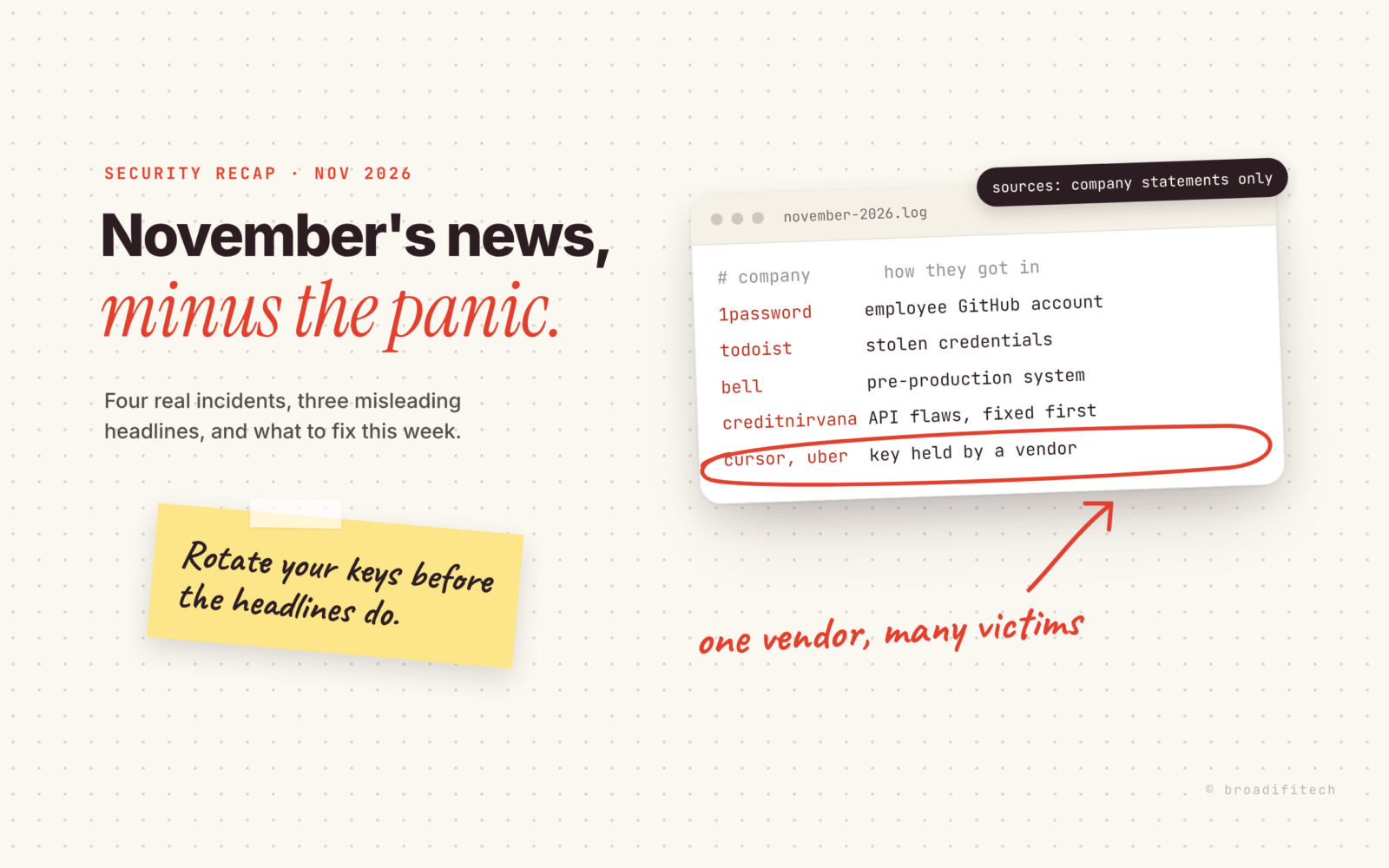
November was quieter on the scary-headline front than October, but it was busier where it counts. Almost every serious incident this month started the same way: somebody’s key. An employee’s GitHub account. A set of stolen credentials. An access key sitting with a vendor. A password someone pasted into a support email two years ago.
That’s the theme of this month’s recap: attackers borrowed keys that were already lying around. Nobody had to be clever. They had to be patient.
Same format as last month’s recap: what happened, who it affects, the one fix, and which headlines got it wrong. Every fact links to its source. No fear-mongering, and no mocking anyone who got hit. It can happen to any of us.
1Password: one GitHub account, straight into the backend
1Password started investigating on 19 November after spotting signs that an employee’s corporate GitHub account was compromised. According to BleepingComputer’s report, the attacker used that account to reach private repositories and insert malicious code into backend services, which then pulled customer account records: names, emails, account IDs, timestamps, public keys and some invitation and recovery tokens. The company says customer vaults and the keys protecting them were not compromised, only a small number of users were affected, and they have been told individually.
1Password has disabled the account, revoked the token, restored services from clean versions and rotated infrastructure credentials. It is not asking users to change passwords.
The one fix for you: treat every engineer’s GitHub account as a production credential. Hardware keys or passkeys for 2FA, short-lived tokens, and no path from a merged commit to a running backend without a second person looking at it.
Todoist: stolen credentials, then source code, then production
Todoist told users that an attacker used stolen credentials to get into its version control system and source code on 22 and 23 November, changed internal access controls, and then reached production through an employee’s work account. TechCrunch reports that about 6% of customers were affected. Taken data includes emails, password hashes for early accounts on an older hashing method, and Todoist API and Slack integration tokens.
The detail that stuck with me: for a tiny group of users, the attacker searched tasks, comments and attachment names for API keys and access tokens. They knew people paste secrets into to-do apps. We all do it.
The one fix: if you use Todoist, reset your password, regenerate API tokens and reconnect integrations. Then search your task app, your tickets and your chat for anything that looks like a key, and rotate what you find.
Fireworks AI: one vendor key, two very different victims
This one started in early October and kept unfolding all month. Attackers got hold of an access key stored at Fireworks AI, an AI model provider. Cursor says they used it to copy a storage bucket of older coding-agent traces, and some of those traces contained API credentials. From there they got a marketplace credential and, on 29 October, published malicious copies of the Claude Code extension to Cursor’s marketplace cache for about 11 hours. Cursor estimates up to 5,000 users may have received them. The fake builds tried to add an attacker SSH key and keep remote access.
Separately, Uber is notifying just under 150,000 drivers that their names, licence numbers, dates of birth and addresses were stolen in the same Fireworks breach.
The one fix: if you installed or updated that extension in Cursor around 29 October, follow Cursor’s remediation notice and check ~/.ssh/authorized_keys for keys you don’t recognise. For everyone else: scrub secrets from logs and traces before they ever leave your systems, because you can’t rotate what you don’t know a vendor holds.
CreditNirvana: an Indian platform, found by a researcher before anyone else
Our Indian story this month is a near miss, not a confirmed theft. A security researcher found two flaws in CreditNirvana, an AI debt collection platform owned by Indian fintech Perfios. As Privacy Guides summarised from WIRED’s report, the flaws could have exposed 6.6 million accounts and 315,000 call recordings, with credit reports, ID cards, legal documents and collection messages, across three corporate customers. The flaws have been fixed. I haven’t seen any report that someone actually abused them, and the exposure may have lasted years.
The one fix: test every API endpoint as a logged-out user and as the wrong customer. It’s the same lesson as the fields your API leaks without you noticing, just at a much bigger scale.
What the headlines got wrong
What was said: “Chase, Visa and Mastercard hacked.”
What it means: Chase said third parties who provide services to the firm were attacked and that attackers accessed certain marketing data held by those vendors. Visa said its own systems were not involved and no card numbers were affected. Mastercard said a limited number of email addresses from one benefit programme were exposed. The vendor hasn’t been confirmed.
What to do: expect phishing that uses your real name and email. And for your own business, list every vendor that holds a copy of your customer data, even “just marketing data”.
What was said: “3.5 billion records leaked.”
What it means: researchers found two unrelated unsecured databases. One held about 2 billion credentials that appear to come from infostealer malware, which steals saved logins from infected computers. That’s a huge pile of recycled stolen data, not one company getting breached for 3.5 billion records.
What to do: a password manager, unique passwords and 2FA. And keep work logins off personal laptops that the kids also use for game mods.
What was said: “AI hacker breaches Bell Canada.”
What it means: Bell said an “agentic threat actor” accessed some of its systems on 17 November and took some enterprise customer data. Bell also said it doesn’t know who did it. The AI angle is the most clicked part and the least explained. The part I’d underline is in the customer notice: the system accessed was a pre-production environment of its ordering tool.
What to do: stop treating staging as a sandbox. If it holds real customer data, it needs production-grade locks.
The pattern, and five habits that close most of it
Read the list again. A GitHub account. Stolen credentials. A key stored at a vendor. Secrets pasted into traces, tasks and support emails. A pre-production system with real data in it. Here’s what I’d do this week:
- Turn on phishing-resistant 2FA (passkeys or hardware keys) for GitHub, your cloud console and your password manager. Start with whoever can deploy.
- Search for pasted secrets in tickets, task apps, chat and support inboxes. Rotate anything you find, then delete the message.
- Make tokens expire. Fine-grained, short-lived tokens beat a classic token that has lived on a laptop since 2023.
- Keep a vendor list with the keys and data each one holds, so a vendor’s breach notice turns into a 20 minute rotation, not a week of guessing.
- Lock pre-production like production, or fill it with fake data. Ideally both.
What this means under DPDP
If you handle personal data of people in India, this part is for you. Under the DPDP Rules, a data fiduciary has to send the Data Protection Board a detailed breach report within 72 hours: what happened, how much, when, where and the likely impact. The main duties, including reasonable security safeguards, apply from 13 May 2027. That’s about five and a half months from today.
The penalty for failing to take reasonable security safeguards can go up to Rs 250 crore. Now picture writing that 72 hour report after an incident like Todoist’s. You’d need to know which tokens existed, who held them and what they could reach. Most small teams couldn’t answer that today, and that’s fine, as long as it changes before May.
This isn’t legal advice. It’s a nudge to start the boring inventory work now.
Before you go
If you want a quick sense of where you stand, there’s a free DPDP readiness check. And if any of November’s incidents touched your stack and you’d like a second pair of eyes, just reach out or write to contact@broadifitech.com.
A new recap goes up at the end of every month. Until then, go find that one token you pasted into a ticket and rotate it.
